
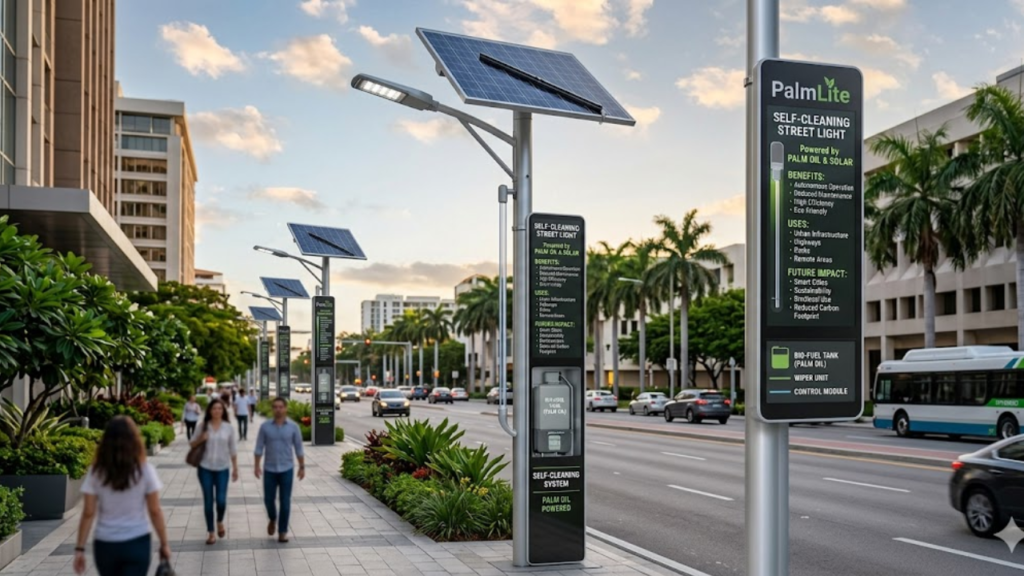

Self cleaning street light palm oil technology is an advanced innovation designed to improve urban lighting efficiency while reducing maintenance costs. It uses palm oil–based coatings that help street light surfaces resist dust, dirt, and water accumulation. This system ensures that lights remain cleaner for longer periods without frequent manual cleaning. It is becoming an important part of smart city development due to its eco-friendly and cost-saving nature. By combining renewable materials with modern surface engineering, it supports sustainable infrastructure growth. It also enhances durability of lighting systems in harsh weather conditions. The technology reduces dependency on chemical coatings that can harm the environment. It improves nighttime visibility on roads and highways. It is being explored in modern infrastructure projects worldwide. Overall, it represents a major step toward greener urban lighting systems.
Who is Behind Self Cleaning Street Light Palm Oil Innovation
Self cleaning street light palm oil research is being developed by environmental engineers, material scientists, and smart infrastructure experts. Their focus is on creating biodegradable coatings that can replace synthetic chemical layers. Palm oil is studied because it is widely available and renewable in many regions. These researchers aim to improve durability, weather resistance, and long-term performance. Their work is helping shape the future of sustainable urban lighting systems. They collaborate with urban planners and energy specialists for real-world testing. Research institutions are actively conducting experiments on coating efficiency. Industrial partners are supporting large-scale development efforts. Continuous innovation is improving stability and performance. The goal is to make lighting systems more autonomous and maintenance-free. Pilot projects are already being tested in selected smart cities. These advancements show strong global potential. The technology is steadily moving toward real-world adoption.
How Self Cleaning Street Light Palm Oil Technology Works
Hydrophobic Surface Protection System
The hydrophobic system in self cleaning street light palm oil technology creates a water-repelling layer on the surface of street lights. This prevents rainwater and moisture from sticking to the lamp surface. As water flows down, it carries dust and dirt away naturally. This process helps maintain clear lighting output in all weather conditions. It reduces the need for manual cleaning and improves long-term efficiency. The coating works at a microscopic level to reduce surface tension. It prevents dirt particles from bonding with metal surfaces. It ensures consistent brightness even in polluted environments. It is inspired by natural self-cleaning effects found in plants. It performs well in both dry and wet climates. It helps extend the operational life of lighting systems. It reduces maintenance interruptions in urban areas. It supports continuous and efficient illumination in cities.
Benefits of Self Cleaning Street Light Palm Oil Systems
Lower Maintenance and Cost Efficiency
Self cleaning street light palm oil systems significantly reduce maintenance frequency. Municipal workers do not need to clean lights as often, which lowers operational costs. This is especially useful for highways and large city installations. Reduced maintenance also improves system uptime and reliability. It creates a more efficient urban lighting network. It reduces labor requirements for cleaning operations. It allows better allocation of public resources. It minimizes disruptions caused by maintenance activities. It improves energy efficiency by keeping lights clean. It extends the lifespan of lighting equipment. It reduces long-term repair expenses. It supports smarter municipal budgeting. It ensures consistent lighting performance with fewer resources.
Applications of Self Cleaning Street Light Palm Oil Technology
Smart Infrastructure and Urban Road Networks
This technology is widely used in smart cities and modern road systems. It is highly effective in dusty, polluted, and coastal environments. Highways, industrial areas, and rural roads benefit the most from this innovation. It supports cleaner and safer public lighting. Governments are increasingly considering it for future infrastructure projects. It is suitable for both developed and developing regions. Urban planners use it to improve lighting reliability. It reduces the need for frequent maintenance crews. It is especially valuable in remote areas with limited resources. The system improves nighttime road safety significantly. It also supports sustainable transportation infrastructure. Many smart city projects include it as part of their design. It enhances overall urban living conditions. It reduces energy waste caused by dirty surfaces. It improves visibility for drivers and pedestrians. It supports long-term infrastructure efficiency. It is becoming a preferred solution for modern urban development.
Environmental Impact of Self Cleaning Street Light Palm Oil
Eco-Friendly Material Usage
Palm oil–based coatings are biodegradable and reduce reliance on synthetic chemicals. This helps minimize environmental pollution caused by industrial coatings. It also supports the use of renewable resources in infrastructure development. The technology aligns with global sustainability goals. It promotes greener urban planning strategies. It reduces carbon footprint in maintenance operations. It helps decrease chemical waste in industrial processes. The use of natural materials supports environmental balance. It encourages sustainable manufacturing practices. It contributes to long-term ecological protection. Cities adopting this technology support climate-friendly initiatives. It improves environmental responsibility in urban systems. It reduces global pollution levels. It lowers greenhouse gas emissions from maintenance work. It protects soil and water quality. It supports circular economy principles. It promotes eco-friendly innovation in infrastructure systems. It also reduces dependency on petroleum-based coatings. It supports long-term biodiversity protection. It encourages cleaner industrial production methods.
Durability and Performance of Self Cleaning Street Light Palm Oil
Long-Term Surface Stability
The coating is designed to maintain performance under different weather conditions. It helps protect street light surfaces from corrosion and environmental damage. Continuous research is improving its lifespan and resistance. This makes it suitable for long-term infrastructure use. It ensures stable lighting performance over time. It withstands high temperatures and heavy rainfall. It reduces degradation caused by environmental exposure. The coating maintains effectiveness for extended periods. It improves structural protection of lighting systems. It enhances resistance against UV radiation. It supports consistent lighting quality in all seasons. It reduces replacement frequency of components. It ensures reliable performance in harsh environments. It prevents surface cracking and material fatigue. It maintains brightness efficiency over long periods. It improves durability in polluted urban areas. It supports sustainable long-term infrastructure investment. It reduces material aging effects. It improves resistance to environmental wear and tear.
Future Development of Self Cleaning Street Light Palm Oil
Integration with Smart City Technology
Future advancements may combine this technology with smart sensors and AI-based monitoring systems. This will allow automatic performance tracking of street lights. Researchers are also exploring nanotechnology enhancements for better efficiency. Such improvements could make the system more durable and cost-effective. It is expected to become a standard feature in modern cities. It may integrate with IoT-based infrastructure systems. Smart diagnostics could detect cleaning efficiency in real time. Automation will further reduce maintenance needs. Energy optimization features may also be added. It will support fully intelligent lighting networks. The system may become self-adjusting based on environmental conditions. It will improve city-wide lighting management. Future cities may fully rely on such smart systems. It may connect with renewable energy grids. Predictive maintenance using AI will enhance reliability. It supports fully automated urban lighting ecosystems. It represents the future of smart infrastructure development. It may integrate with climate monitoring systems. It will enhance adaptive lighting performance in real time.
Challenges in Self Cleaning Street Light Palm Oil Technology
Performance and Scalability Issues
One major challenge is ensuring consistent performance in extreme weather conditions. Large-scale production and cost optimization are also important concerns. Researchers are working to improve coating stability and efficiency. Despite challenges, ongoing development shows strong potential. It is gradually moving toward real-world implementation. Manufacturing consistency remains a technical issue. Scaling production for global use requires investment. Long-term durability still needs further testing. Standardization across regions is necessary. Performance variation in different climates is being studied. Research is focused on improving formulation techniques. Industrial adoption is increasing slowly. However, commercial expansion is still in progress. Supply chain limitations for raw materials also exist. Regulatory approvals may slow adoption. Technical training is required for implementation teams. Continuous innovation is needed for global scalability. Cost reduction strategies are being explored. Global testing programs are still expanding.
Future of Self Cleaning Street Light Palm Oil in Smart Cities
Self cleaning street light palm oil technology is expected to play a major role in next-generation smart cities. It will support automated infrastructure systems that require minimal human intervention. Future cities may rely heavily on self-maintaining lighting networks. This will improve efficiency and reduce operational costs. It will also support sustainable urban expansion. It will integrate smoothly with IoT-based smart city systems. Artificial intelligence may help monitor lighting performance in real time. Energy optimization will become more advanced with automated adjustments. The system may work with renewable energy grids like solar networks. It will reduce dependency on manual inspection teams. Smart sensors will further enhance maintenance prediction. This will make urban lighting fully intelligent and self-regulating.
Role in Reducing Urban Pollution
This technology contributes to reducing urban pollution by limiting the need for chemical cleaning agents. It also reduces waste generated from maintenance activities. Cleaner lighting systems improve air quality indirectly by lowering industrial cleaning demand. It supports greener and healthier city environments. It aligns with global environmental protection efforts. It reduces harmful chemical runoff into soil and water systems. It minimizes emissions from maintenance vehicles and equipment. It encourages the use of biodegradable materials in infrastructure. Dust-free lighting reduces the frequency of cleaning cycles. This lowers overall environmental disruption in cities. It supports long-term ecological balance in urban ecosystems. It plays a key role in sustainable city planning strategies. It also helps reduce particulate pollution caused by frequent maintenance work. It improves urban cleanliness standards over time. It supports healthier living conditions in densely populated areas. It contributes to long-term climate stability efforts.
Energy Efficiency Improvements
Self cleaning street light palm oil systems help improve energy efficiency by maintaining optimal light output. Clean surfaces allow maximum light reflection and distribution. This reduces energy loss caused by dust accumulation. It supports better performance of solar and electric street lights. It contributes to more efficient energy usage in cities. It enhances brightness without increasing power consumption. It ensures stable lighting performance throughout the year. It reduces strain on electrical grids in urban areas. It supports better energy management in smart cities. It improves solar panel efficiency when integrated with lighting systems. It reduces unnecessary energy waste from dim or blocked lighting. It helps cities achieve better sustainability targets. It supports long-term energy conservation goals. It also stabilizes voltage demand in large lighting networks. It enhances renewable energy integration efficiency. It reduces overheating of lighting components. It supports smarter energy distribution systems in urban infrastructure.
Cost Saving Benefits for Governments
Governments benefit financially from reduced maintenance and cleaning costs. The technology lowers long-term infrastructure expenses. It reduces the need for frequent manpower deployment. It also decreases equipment replacement costs. This makes it a cost-effective solution for large-scale adoption. It reduces budget pressure on municipal authorities. It allows funds to be redirected to other infrastructure projects. It decreases operational downtime of street lighting systems. It minimizes emergency repair requirements. It improves financial efficiency in public infrastructure management. It supports long-term economic sustainability. It helps governments manage large urban networks more effectively. It is a practical solution for budget-conscious development projects. It also reduces procurement and logistics expenses. It improves return on infrastructure investment. It decreases dependency on external maintenance contractors. It supports more efficient public spending strategies.
Public Safety Enhancement
Better lighting quality directly improves public safety in urban and rural areas. Clear and bright roads reduce accident risks at night. It improves visibility for drivers, pedestrians, and cyclists. It also helps enhance security in public spaces. This makes cities safer and more reliable. It reduces crime opportunities in poorly lit areas. It improves surveillance effectiveness in smart cities. It ensures safer travel during night hours. It supports emergency response visibility. It reduces road hazards caused by poor lighting conditions. It improves pedestrian safety in busy urban zones. It enhances overall urban security systems. It contributes to safer community environments. It also supports better traffic flow at night. It improves detection of obstacles on roads. It enhances public confidence in night travel. It supports safer transportation infrastructure overall.
Rural Infrastructure Development
Self cleaning street light palm oil technology is highly useful in rural areas. These regions often lack maintenance resources and infrastructure support. The system reduces the need for frequent servicing. It ensures consistent lighting in remote locations. This supports rural development and connectivity. It improves nighttime safety in villages and remote roads. It reduces dependency on maintenance teams in far areas. It supports agricultural and local transport activities. It helps improve education and healthcare access through better lighting. It strengthens rural economic development. It enhances communication and mobility in remote regions. It supports balanced infrastructure growth between urban and rural areas. It brings modern lighting solutions to underserved communities. It also reduces infrastructure inequality between cities and villages. It improves rural digital and transport connectivity. It supports nighttime economic activities in rural markets. It enhances overall quality of rural life.
Industrial and Highway Applications
Industrial zones and highways benefit significantly from this technology. These areas experience high levels of dust and pollution. The self-cleaning coating ensures long-lasting performance. It reduces maintenance interruptions on busy routes. It improves operational efficiency in industrial environments. It ensures continuous lighting in high-traffic areas. It reduces downtime caused by cleaning operations. It enhances worker safety in industrial zones. It improves highway visibility for fast-moving vehicles. It supports uninterrupted transportation systems. It reduces maintenance risks in hazardous environments. It increases reliability of critical infrastructure. It helps maintain smooth industrial operations. It also reduces accident risks in industrial corridors. It supports 24/7 operational environments. It improves logistics and freight transport safety. It ensures stable lighting in extreme working conditions.
Sustainability and Green Technology Growth
This innovation supports the global shift toward green technology. It reduces dependency on non-renewable materials. It encourages the use of natural resources like palm oil. It aligns with sustainability and climate goals. It helps build environmentally responsible infrastructure systems. It promotes circular economy principles in construction. It reduces carbon footprint of urban maintenance systems. It supports global climate action initiatives. It encourages eco-friendly innovation in engineering. It reduces industrial chemical usage in cities. It improves long-term environmental balance. It supports global efforts toward net-zero emissions. It strengthens sustainable urban development practices. It also accelerates adoption of renewable-based infrastructure solutions. It supports innovation in bio-material engineering. It promotes responsible industrial development practices. It helps create future-ready sustainable cities.
FAQs
What is self cleaning street light palm oil technology?
It is a system that uses palm oil–based coatings to keep street lights clean and reduce maintenance.
How does it work?
It works by creating a hydrophobic surface that repels water and removes dust naturally.
Is it environmentally friendly?
Yes, it uses biodegradable palm oil derivatives that reduce environmental impact.
Where can it be used?
It can be used in cities, highways, rural roads, and industrial zones.
Does it reduce costs?
Yes, it lowers maintenance and cleaning expenses significantly.
ReadMore:Ava Safdie Biography 2026 Indie-Pop Singer Career Music Style Journey Explained
Final Thought
Self cleaning street light palm oil technology is a promising innovation that combines sustainability with modern engineering. It reduces maintenance, improves efficiency, and supports eco-friendly urban development. With continued research, it has the potential to become a key part of future smart city infrastructure. It also encourages the use of renewable materials in public systems. The technology can significantly transform urban lighting management. It supports long-term environmental protection goals. It improves energy efficiency across cities. It reduces operational burdens on governments. It enhances road safety and visibility. It promotes smart infrastructure development worldwide. It represents a major shift toward greener and smarter urban planning. It also strengthens the adoption of bio-based industrial materials in infrastructure. It can help cities move closer to carbon-neutral development targets. It encourages innovation in sustainable engineering practices. It creates a foundation for fully automated and self-maintaining urban systems.